 Loading search...
50 Shades of Desert By Mike Unwin
Mike Unwin is an award-winning travel writer specialising in wildlife and conservation. In March, he joined our new Wildlife of the Moroccan Sahara tour, sharing his beautiful words and images on his return. His article, 50 Shades of Desert, was originally published in Travel Africa Magazine, Issue 112, and is reproduced here with kind permission.
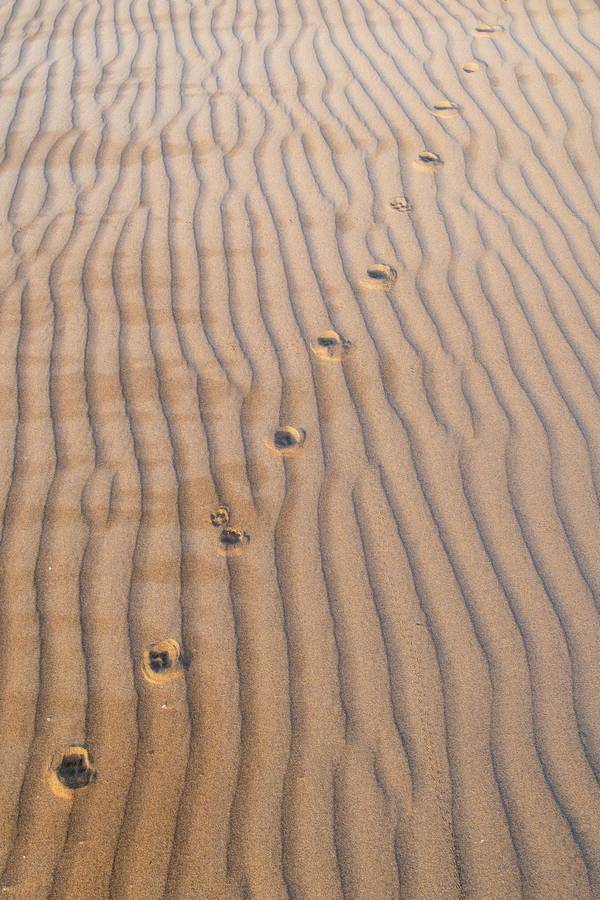
It’s just a ripple in the sand; a wavy, serpentine line, embroidered on the dune face, as though a child has traced the pattern with a stick. Except there are no children’s tracks here — or, indeed, tracks of any kind. And the line, about eight metres long, is fading as we watch, the wind erasing its contours as surely as an etch-a-sketch drawing.
Brahim is quick off the mark, sprinting over the dune — as only he seems able to — towards the mysterious vanishing pattern. Where it ends, he plunges his hand into the sand and deftly extracts a gleaming, wriggling creature.
“Sandfish,” he says, as we catch up and crowd around. “Take a look.”
The White-banded Sandfish is, of course, not actually a fish. Rather, it’s a lizard — a member of the skink family — that ‘swims’ through the sand with fish-like undulations of its smooth body, tiny limbs pressed flat against its sides. That rippled pattern on the dune face is the sign it leaves of its progress just below the surface.
Up close, we can appreciate the animal’s strange beauty: its polished, fish-like scales, its fringed toes — for extra traction — and the trowel-shaped snout with which it ploughs through the sand. Brahim replaces it exactly where he found it, careful not to cause any further stress. For a minute, the puzzled reptile plays dead, coiled motionless on the sand. Then, realising it’s free to go, it disappears downward with astonishing speed.
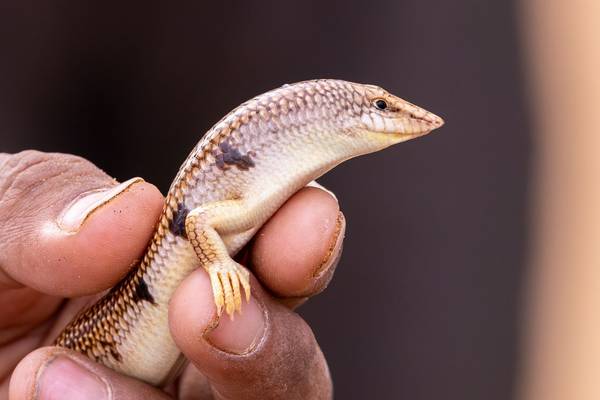
Sandfish (Mike Unwin)
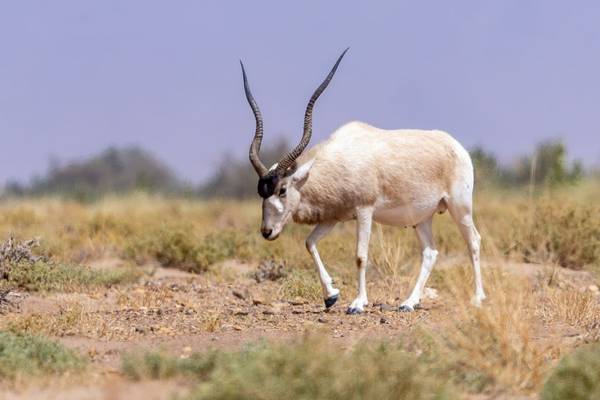
Addax (Mike Unwin)
The sandfish’s snout reminds me of the Namib Desert’s Shovel-snouted Lizard, also an adept sand burrower. In fact, the two are not closely related (other than being lizards): the latter belongs to the Lacertidae family of ‘true lizards’ rather than the skinks. But together they offer a lovely illustration of convergent evolution: the principle by which creatures in different parts of the world, from unrelated backgrounds, acquire similar adaptations to meet the same environmental challenges — in this case, sand.
It’s also a reminder of how little I know about the wildlife of the Sahara. This is by far Africa’s largest desert and yet many regular Travel Africa readers — me included — are, I suspect, much more familiar with the wildlife of the Namib. The Sahara may be over 100 times larger, but in wildlife tourism terms it receives just a fraction of the coverage enjoyed by its southern African cousin.
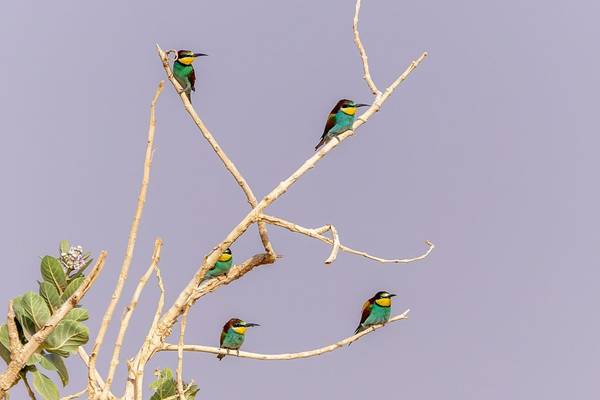
European Bee-eaters (Mike Unwin)
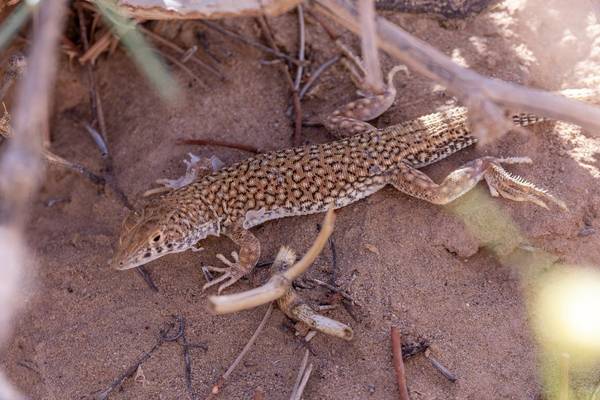
Small-spotted Lizard (Mike Unwin)
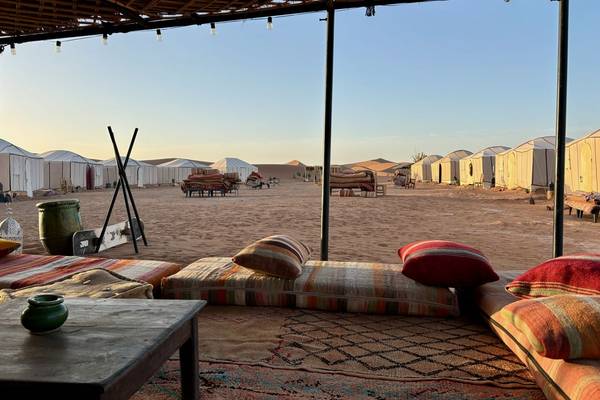
Camp (Mike Unwin)
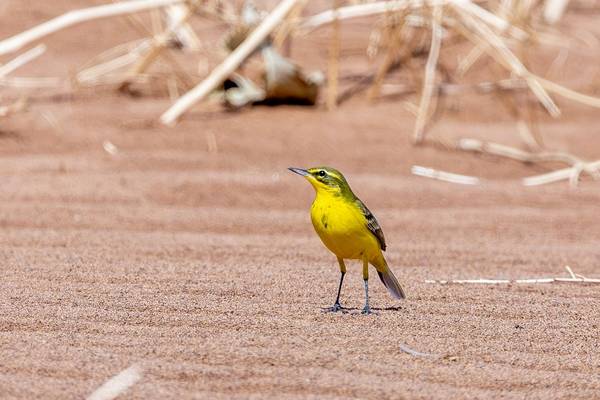
Yellow Wagtail (Mike Unwin)
This particular chunk of the Sahara is Iriqui National Park, in south-eastern Morocco, close to the Algeria border. I’m here on a 7-night adventure with Naturetrek Wildlife Holidays. Brahim Elbarbouchi is our guide, leading us on daily excursions — both on foot and by 4WD vehicle — to discover the desert’s wildlife secrets. Tonight’s stroll is just a taster; a chance to check out the lie of the land.
Around us loom the crescent dunes of Erg Chigaga — the highest in Morocco — and the discreet cluster of white Bedouin-style tents behind us is our camp. We arrived a short while ago after a long drive from the coast, winding over sandstone escarpments, gravel plains and the vast dusty expanse of the dry Iriqui lakebed. Fifty shades of desert.
The wind erasing the tracks is, it turns out, a prelude to rain. Not what I expected. It drums on the canvas overnight and when I open the flaps at dawn — awoken, as every subsequent morning, by the whistled melody of a White-crowned Wheatear — I find the staff are already packing up the camp’s sodden rugs and cushions.
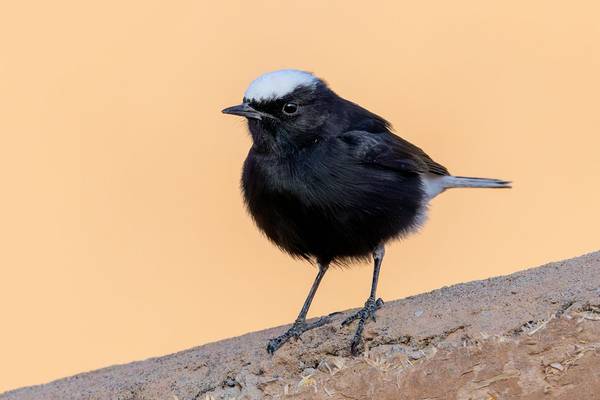
White-crowned Wheatear (Mike Unwin)
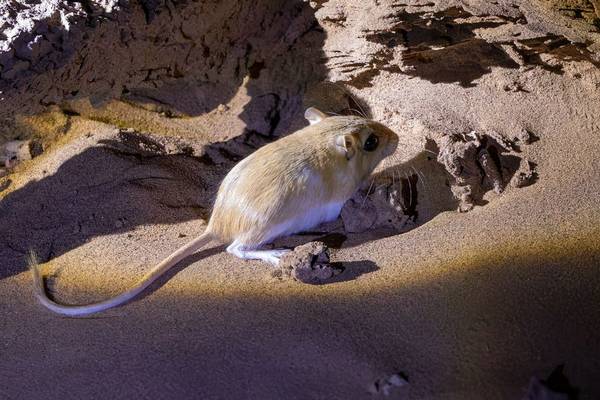
Lesser Egyptian Gerbil (Mike Unwin)
After breakfast, we head out on foot along a dry riverbed. Away from the dune fields, the desert floor is more vegetated, its crusted surface supporting a sparse growth of Calotropis bushes and scattered Tamarisk trees. Every patch of sand is crisscrossed with the signatures of its commuters. Brahim helps us distinguish lizard from lark and gerbil from beetle.
Soon, we spy the first standing water from last night: a ribbon of blue reflecting the now clear sky. Except the water is not standing, but moving. At first, shy rivulets creep around our toes, as though poured from a bucket onto a beach. As we watch, these swell into lustier streams, gaining speed and volume. It seems a river is being born before our eyes.
We retreat to higher ground and are soon looking back on a leaping, foaming body of water fully 50m wide. It races across the desert floor as channels converge and divide, turning hillocks into islands and surging past us towards the horizon. This is disastrous for the desert ground-dwellers, the water inundating the labyrinth of burrows and tunnels that house countless insects, reptiles and rodents. We spy one bedraggled gerbil, which just manages to escape the current and pull itself onto the safety of a tussock. I don’t like to think of the many others that weren’t so lucky.
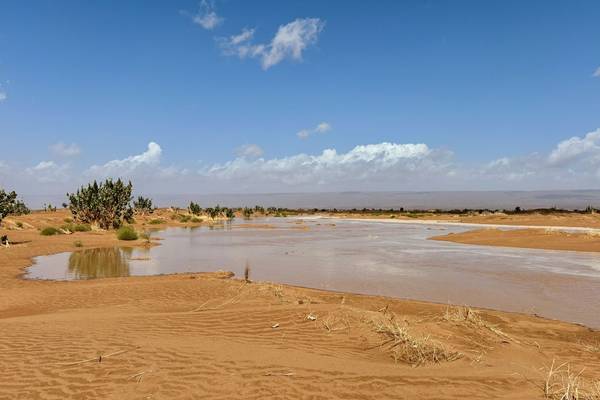
River appearing (Mike Unwin)
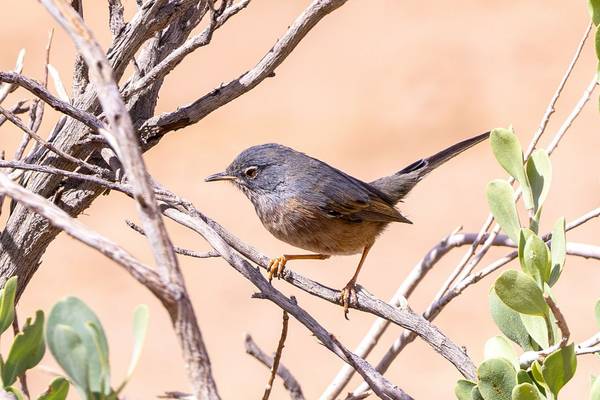
Tristram's Warbler (Mike Unwin)
For birds, however, it’s a bonanza. A small army of feathered opportunists is assembling to pick off the exodus of minibeasts. Some, such as Maghreb Larks and Tristram’s Warblers, are resident species, but there are also numerous Afro-Palearctic migrants that have spent winter further south and are now heading back towards European breeding grounds. Excited shouts go up as we tick off such beauties as Yellow Wagtail, Redstart and Bluethroat darting and fluttering at the water’s edge. Swallows and Bee-eaters swoop after airborne insects overhead.
That’s the last of the rain. Perhaps for years.
As the week continues, we explore further into the desert by vehicle. It’s easy to zone out as we rumble on through the seemingly featureless terrain, lulled by the jangle of Tinariwen’s desert blues and disorientated by dust storms that swallow the horizon. But Brahim’s eyes and ears miss little. He points out a small party of Dorcas Gazelles sending up dust detonations as they gallop beside us, and the chuckling calls of Spotted Sandgrouse wheeling round to alight at a waterhole. Such sightings prompt further parallels with the Namib: for the gazelles read Springbok and for the Spotted Sandgrouse read Namaqua Sandgrouse.
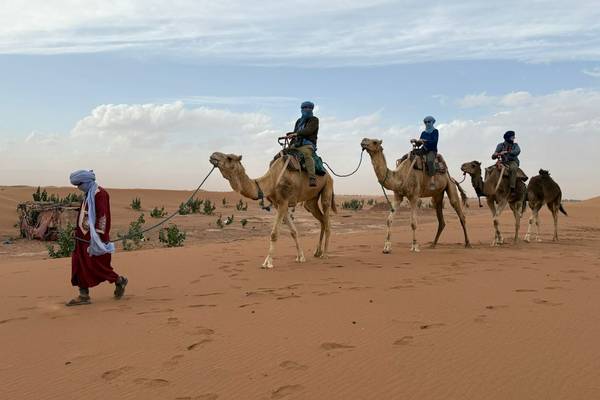
Mike (left) enjoying a camel ride
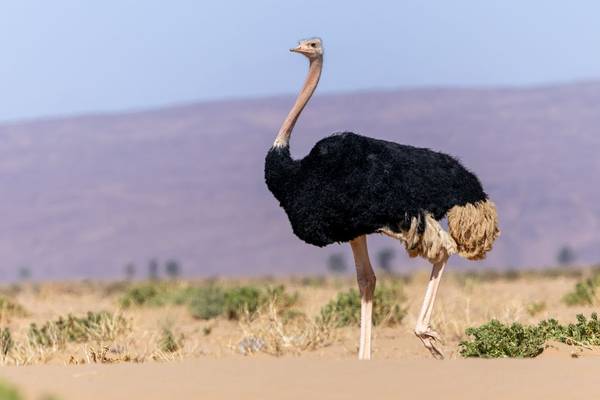
Ostrich (Mike Unwin)
But where today’s Sahara differs from the Namib is in the dearth of larger creatures. They were here once — even Lions. Sadly, centuries of hunting wiped out most of the predators, bar a few shy Caracals and Striped Hyenas that even Brahim has never seen, while the skittish gazelles are all that remain of the vast antelope herds that used to cross the desert in their millions.
But all is not lost. On day four, we come across a small herd of Addax, one of the rarest mammals on the planet. This white, spiral-horned relative of the oryx once roamed the Sahara from east to west. Today, fewer than 400 survive in the wild, confined largely to tiny pockets in Chad and Niger. But in 2019, a far-sighted conservation programme saw the antelope reintroduced to this remote corner of Morocco, where they are now thriving.
Addax are true desert specialists, able to withstand brutal summer temperatures and survive for months without drinking water, thus making them the Saharan equivalent of Namibia’s Gemsbok. (Snap! Another desert matchup.) And they’re not the only lost piece of the Sahara’s wildlife jigsaw puzzle to have been recently restored. We also find a party of Ostriches. These enormous birds — here in their red-necked North African race — now roam the land of their birthright once again, striking as distinctive a profile on the Sahara horizon as the ubiquitous camel trains.
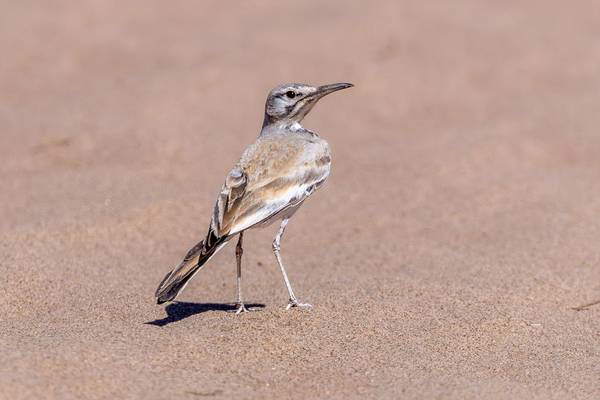
Greater Hoopoe-lark (Mike Unwin)
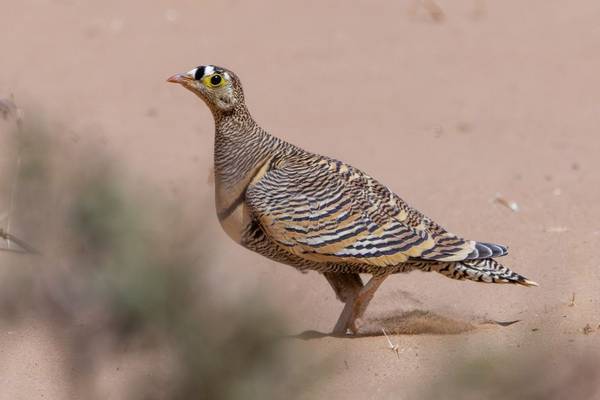
Lichtenstein's Sandgrouse (Mike Unwin)
There is, however, one Saharan creature with no direct Namibian equivalent. The Fennec Fox has topped my wish list since we arrived but, like most desert mammals, this diminutive creature (at just 1–1.5kg, it’s meerkat-sized) is nocturnal, so sightings are rare. A torchlit night walk produces more gerbils and a Desert Hedgehog, but not my hoped-for canid. I’m soon resigned to seeing no more than its tiny tracks in the dunes.
Until, on day five, an animal dashes across the road. A hare? No, too fluffy; too pale. It stops for a brief backward glance — just enough time to get my binoculars on a cute foxy face with ludicrously enormous ears. Bingo! A Fennec. Then it’s gone, swallowed by a burrow.
The week has more treats in store. We visit a sacred oasis, where Sahara Frogs belch from a pool beneath the date palms. We trudge, by camel, deep into the dunes, before dismounting to scramble up the highest. We continue to lengthen our bird list, ticking such Sahara specials as Cream-coloured Courser, Greater Hoopoe-lark and — my favourite — a party of exquisitely camouflaged Lichtenstein’s Sandgrouse. And back at camp, we consume our bodyweight in sumptuous shakshoukas and tagines.
Our last evening finds me clambering up a dune for a final pre-dinner attempt at the requisite sunset shots. The desert panorama is magnificent, but also terrifying in its immensity. Unfathomable. At my feet, a Scarab Beetle is labouring valiantly up behind me, now traversing the craters of my footsteps. Equally impressive, in its own humble way.
Sometimes, when places are just too big, it pays to think small.
View tour